How many product photos per product do you actually need?
Marcel Timmerman · Published 8 augustus 2026 · Last updated 25 September 2026
The short answer: for clothing, five to eight photos per product is the norm — a main shot, the back view, a detail shot, a model shot and a lifestyle shot. The long answer depends on your category and sales channel, and there's a point where an extra photo stops adding value. This article gives you the rules of thumb.
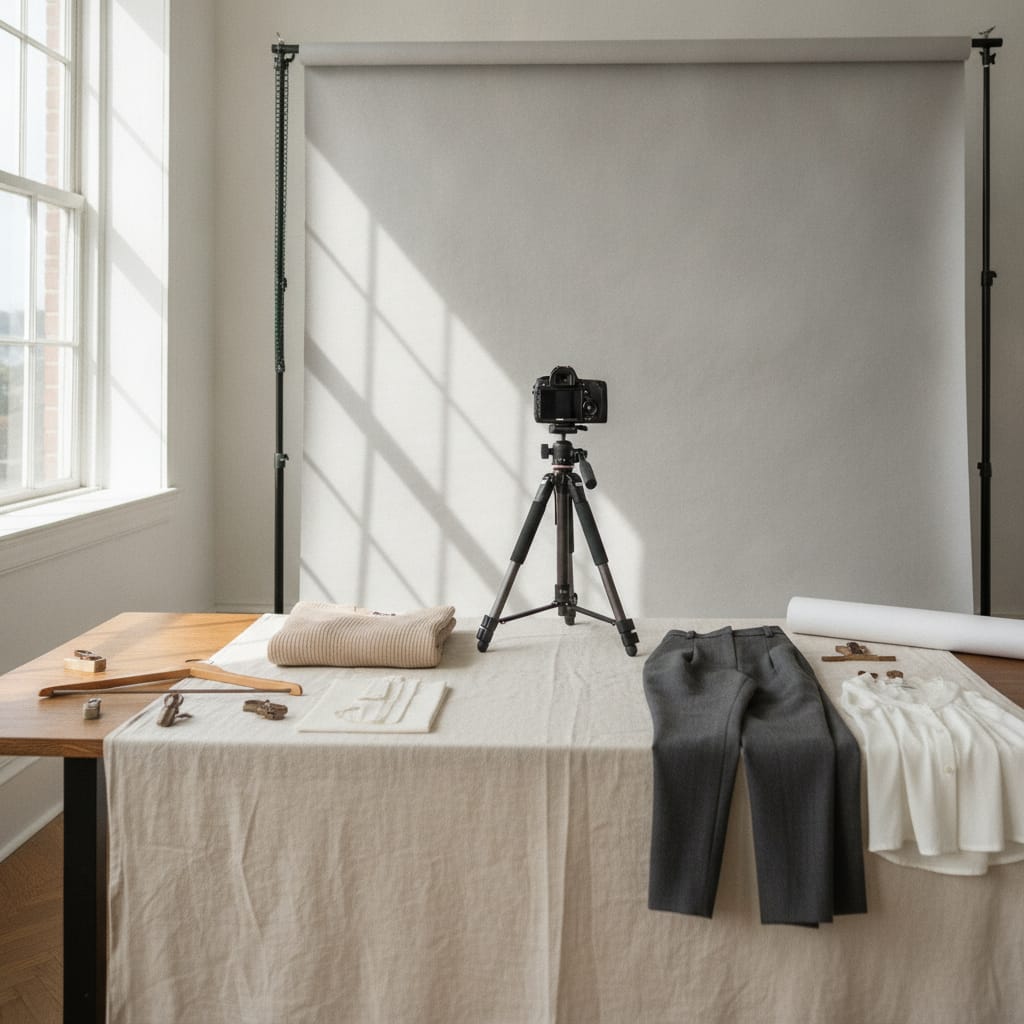
The right number of product photos per garment
- The basic set for clothing is five images: main shot, back view, detail, model and lifestyle.
- The industry works with roughly eight images per product; under three photos, you're demonstrably losing conversion.
- What counts differs per category: with jeans the back view is half the story, with coats it's the volume, with dresses it's the drape.
- Marketplaces set a minimum (and sometimes a maximum); your own webshop is up to you — but load time sets a practical limit.
- A short product video often does more than an eighth photo: movement shows what a still can't.
The basic set: five images that each answer a question
A buyer who can't touch a garment mentally runs through a list of questions: what does it look like, how does it look from behind, how does the fabric feel, how does it fit, and does it suit me? Every product photo should answer one of those questions — and that instantly sets the minimum count.
The main shot shows the product straight-on, neutral and sharp. The back-view photo answers a question that surprisingly often goes unanswered: for trousers and jeans, the back view is even the image the purchase decision hinges on. The detail shot shows fabric, stitching and finish — the stand-in for touching it in-store.
The model shot shows how the garment drapes and fits on a real body. For clothing, it's the single most persuasive image type, especially with sizing info added ("model is 5'10" and wears size M"). The lifestyle shot, finally, adds context and emotion — this is the image for the almost-convinced shopper on the fence.
Get these five right and you have a complete product page. Anything beyond that is refinement: a second pose, a close-up of a special detail, a colour variant. Useful, but not a requirement.
- Main shot: the product straight-on, neutral
- Back view: essential for trousers and coats
- Detail shot: fabric and finish, the stand-in for touch
- Model shot: fit and drape, the most persuasive image
- Lifestyle shot: context and emotion, for that last bit of doubt
What actually matters differs per category
The count matters less than the mix — and that mix varies by category. With jeans, the back view is half the selling point: pocket placement, stitching and fit around the hips. A denim page without a back view is only half a page, no matter how many other photos you add.
With coats, it's all about volume and material: a detail shot of the filling, zipper and hood does more there than a third front-facing angle. With dresses, the drape is the story — and that's exactly where a short video often beats yet another photo.
Accessories are the exception to the model-shot rule: a piece of jewellery or a bag in a full-body shot is too small to judge properly. There, a detail crop should be the main image, with the model shot providing scale as context.
The rule of thumb per category: start with the basic five, then swap or add at the point where your category's purchase decision actually gets made. That point is almost always known — it's the question customers raise most often in reviews and return reasons.
Marketplace requirements: the minimum is fixed, the optimum isn't
If you sell through marketplaces, part of the choice is already made for you. Amazon and Bol want a main image on a white background and accept a series of additional images alongside it; Zalando asks for multiple angles on a neutral background; Etsy gives you ten slots and rewards sellers who fill them.
The pattern across all platforms: the minimum is two to three images, the optimum is higher. Listings with a full set of images convert better than bare ones — buyers want to be able to look the product over from every angle.
What matters is that requirements differ per channel without your product changing at all. The same upload can produce a white-background shot for Amazon, a neutral model shot for Zalando and a lifestyle shot for Etsy; which photos you deliver varies, how much work it takes doesn't have to.
Your own webshop has no external minimum, but it does have an internal law: consistency. Six photos for one item and one for another makes your store look like half the shelves are empty.
When extra photos stop paying off
There's a saturation point. A buyer who's still on the fence after five good images is rarely won over by a sixth photo of the same garment from a slightly different angle — that doubt is usually about size, price or delivery, and you solve that with information, not imagery.
Extra photos also carry a cost that never shows up on the invoice: load time. Every photo adds bytes, and a slow-loading product page demonstrably costs conversion — especially on mobile, where most fashion shoppers buy. Ten heavy photos can end up selling less, net, than five fast ones.
The smarter investment after the basic set is usually movement: a five-second product video shows drape, stretch and motion — exactly what a still image can't. At FashionPix, a clip like that costs 7 credits — still a fraction of what a videographer charges.
The second smart investment is variety over volume: the same item on a second model with a different build tells a buyer more than a sixth photo of the same model.
- After five good images, information solves more than an extra image
- Every photo costs load time, and load time costs conversion
- A 5-second video > an eighth photo: movement shows what stills can't
- Variety (different model, different build) > volume (yet another angle)
Frequently asked questions
What's the absolute minimum number of product photos?
Two: a main shot and a detail shot. But for clothing, that's truly a bare minimum — without a model shot, buyers miss the fit, and fit is the top return reason in fashion. Three to five is the workable minimum, five to eight the norm.
Is more photos always better for conversion?
Up to around five to eight images, yes; beyond that it flattens out and can even backfire due to load time. The mix matters more than the count: five images that each answer a different question beat ten variations on the same front-facing shot.
Does every photo need a model?
No. The strongest set combines: one or two model shots for fit, a flat-lay or ghost shot for the overview and marketplace listing, and a detail shot for the fabric. For accessories it's the reverse: detail first, model shot as context.
How much does a complete set cost?
With a classic shoot, you'll quickly pay € 60 to € 100 per item. With FashionPix, the complete set — four images plus all the product copy — comes from a single uploaded photo and costs 5 credits per item.
Written with the help of AI and reviewed by Marcel Timmerman, founder of FashionPix.
Read more
- Product photo size for webshop
- Packshot or lifestyle
- Reduce Returns
- Clothing Photos for Instagram
- Jeans fotograferen
- Productfoto’s met model zonder fotoshoot
- Kleding fotograferen voor je webshop
- The assembly line
- FashionPix — Product photos, video and copy for your fashion webshop
The complete set from one photo?
Main shot, model shot, detail shot and the copy to go with it — all from one upload. Your first model photo is free, no account and no credit card needed.