Virtual fitting room ecommerce: smart technology or costly experiment?
Marcel Timmerman · Published 3 juli 2026 · Last updated 25 September 2026
A virtual fitting room lets shoppers try on clothing digitally before buying. Sounds ideal, but the implementation is complex and expensive. Realistic model photos often offer a more accessible alternative that helps visitors decide just as well — or better.
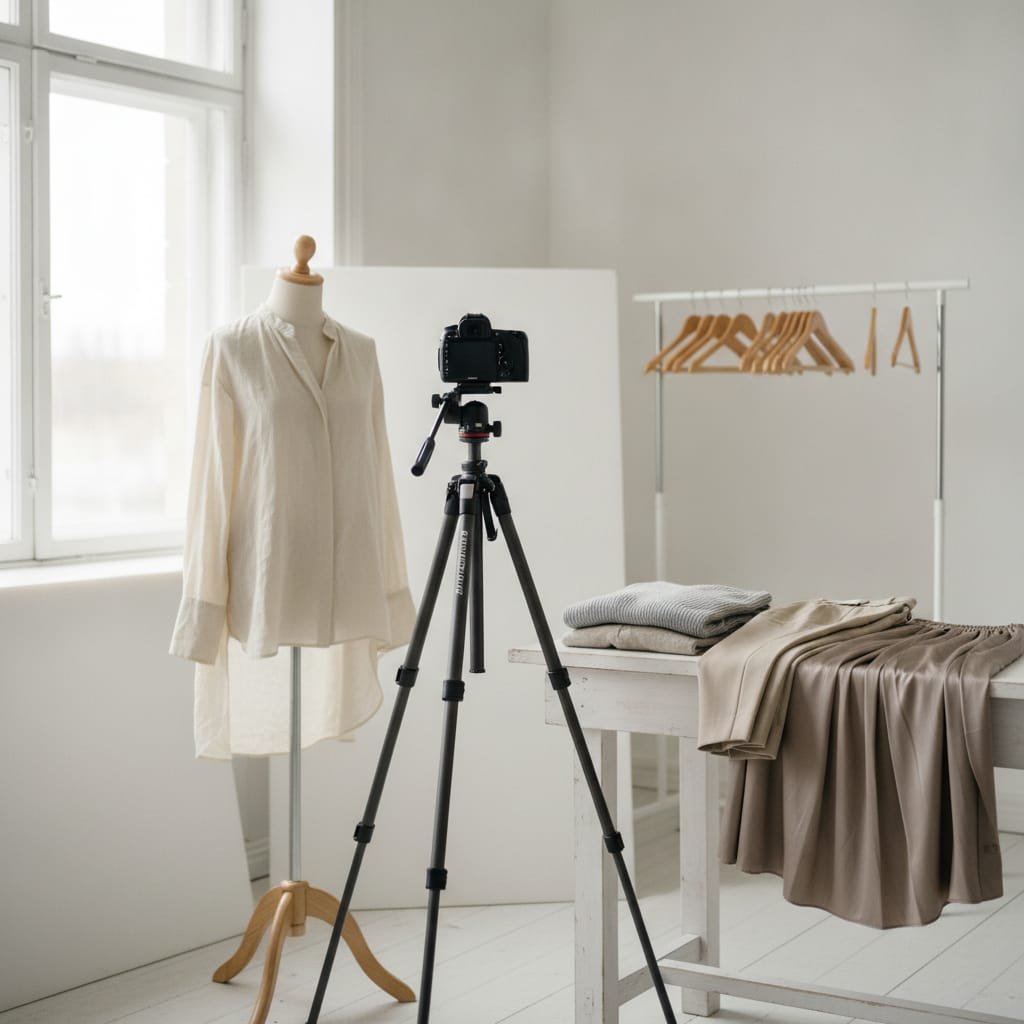
Virtual fitting room vs. model photos: what works for you?
- A virtual fitting room requires a significant technical investment and is mainly feasible for larger online stores.
- Realistic model photos on a relatable body remain the most proven way to present clothing convincingly.
- AR clothing try-on works best as a complement to strong product photography, not as a replacement.
- Tools like FashionPix make professional model photos accessible without a physical photoshoot.
- The right choice depends on your budget, assortment and technical capacity — there's no one-size-fits-all winner.
What is a virtual fitting room and what does it cost?
A virtual fitting room is a digital tool that lets shoppers visualize clothing on an avatar or their own body using AR or 3D technology. Costs range from a monthly SaaS subscription to a fully custom integration, depending on the chosen solution and platform.
There are roughly two flavors: augmented reality, where the shopper uses their phone camera to project clothing onto their own image, and avatar-based systems, where a 3D model is configured based on measurements or body shape. Both require solid product data — think 3D scans or detailed size specifications.
Entry-level costs for an off-the-shelf SaaS solution quickly reach a few hundred euros a month, while a fully custom implementation for a larger online store can run into the tens of thousands of euros. On top of that come ongoing costs for maintenance, updates and supplying 3D product data for every new item.
Many virtual fitting room providers target larger retailers with a broad assortment and a technical team that can manage the integration. That makes the barrier high for smaller or mid-sized webshops — not just financially, but operationally too.
- SaaS subscriptions: monthly cost, quick implementation, limited customization
- Custom integration: higher investment, more control, longer timeline
- Supplying 3D product data takes time and money per item
- Technical maintenance is an ongoing expense
How does AR clothing try-on work in practice?
AR clothing try-on digitally projects a garment onto the shopper's image via the camera of a smartphone or tablet. In practice, this works best for accessories and flat items; for clothing with volume, drape and movement, the technology still has limits.
The technology has made big strides in recent years, but still runs into a fundamental problem: clothing behaves differently on every body. How a blouse falls on someone with broad shoulders differs meaningfully from how the same piece sits on a slimmer frame. AR systems simulate this behavior, but the simulation is rarely as convincing as a real photo on a real model.
On top of that, AR clothing try-on requires active participation from the shopper: opening the app, aiming the camera, moving around. That's an extra step in the customer journey that not everyone wants to take. Shoppers generally choose the path of least resistance — if a photo already convinces them, they don't need the AR feature.
AR is valuable as a complement: for shoppers who are unsure about color or fit, it can tip the scale. But if your product photography is already weak, AR won't fix that — it's more likely to expose it. Want to know where your visuals currently stand? Check out improving product photos.
Why do realistic model photos drive higher conversion?
Realistic model photos on a relatable model give shoppers instant context: how does the piece fall, how long is it, how does the waist sit? That visual information lowers uncertainty and boosts confidence in a purchase.
People buy clothing because they can picture themselves in it — a feeling, an occasion, a version of themselves. A photo on a model tells that story at a glance. The drape of the fabric, the length relative to the body, the way a collar sits: these are details shoppers need to make a decision.
Research from the Baymard Institute on e-commerce usability shows that insufficient product images are one of the most cited reasons shoppers abandon a purchase. More and better images — especially on a model — directly reduce that hesitation.
An added benefit of model photos is consistency. Every shopper sees the same image, regardless of device or environment. With AR visualization, quality depends on the shopper's room lighting, camera quality and the accuracy of entered measurements.
Finally, model photos are easy to reuse: in emails, on social media, in ads. An AR visualization only lives on the product page.
- Instant visual context on drape, length and fit
- Consistent image on every device and in every setting
- Reusable across multiple channels
- No technical barrier for the shopper
What are the limitations of clothing visualization technology?
Clothing visualization via 3D or AR has two structural limitations: the quality of the simulation depends on accurate product data, and the technology still can't match the emotional impact of a good model photo.
To realistically simulate a garment, you need detailed data: fabric weight, elasticity, drape, color accuracy. That data has to be supplied for every single item. For a webshop with a fast-changing assortment — think fast fashion or seasonal collections — that's a logistical challenge.
There's also the question of diversity. A virtual fitting room works best when shoppers can recognize themselves in the model or avatar. That requires a broad range of body types, skin tones and sizes in the system. Building that out takes time and resources.
It's also worth recognizing that the technology is still very much evolving. What's a limitation today might be solved in two years. But for most webshops, it's not yet a mature, affordable standard solution.
How does FashionPix offer an accessible alternative?
FashionPix generates realistic model photos of clothing without you having to organize a physical photoshoot. You upload a photo of the garment, choose a model and style, and receive images ready to use on your webshop right away. That makes professional clothing visualization accessible to online stores of any size.
The practical advantage is speed and scalability. Organizing a traditional photoshoot takes time, logistics and budget — booking models, arranging a studio, shipping clothing back and forth. For webshops with a large or fast-changing assortment, that's a bottleneck. FashionPix solves this by making the process digital.
The images FashionPix produces are photorealistic and show clothing on a model in a relatable context. That gives shoppers the same visual information as a traditional model photo: drape, length, fit and mood. Without the technical barrier of a virtual fitting room and without the logistical burden of a physical shoot.
FashionPix isn't a direct replacement for virtual fitting room technology — it's a different solution to the same problem: how do you show a shopper what a garment really looks like? For most webshops, a convincing model photo is the most direct and reliable way to answer that question.
- No physical photoshoot needed
- Scalable for large or fast-changing assortments
- Photorealistic images ready to use on product pages right away
- Lower barrier than a full virtual fitting room implementation
When is a virtual fitting room actually the right choice?
A virtual fitting room makes sense if you have a large, stable assortment, a technical team for the implementation, and a target audience that clearly benefits from interactive fit visualization — for example with made-to-measure clothing or lingerie. For most webshops, it's a complement, not a replacement for strong product photography.
If your webshop serves a niche where fit is the biggest purchase barrier — think tailored suits, sportswear or swimwear — a virtual fitting room can lower that barrier. The investment is then justified because it directly removes a pain point for the shopper.
For larger retailers with a technical team and a stable assortment, the investment can also pay off through lower return rates. Returns are one of the biggest cost items in fashion e-commerce, and if a virtual fitting room helps shoppers pick the right size, that has a measurable impact.
The honest conclusion is that a virtual fitting room and realistic model photos aren't competitors — they complement each other. But if you have to choose where your budget and attention go, model photos offer the highest return per euro for most webshops.
- Insufficient product images are one of the most cited reasons shoppers abandon a purchase on an e-commerce site. — Baymard Institute – E-Commerce UX Research
- Returns account for a significant share of operational costs in fashion e-commerce, with fit being the most commonly cited reason for returning items. — Statista – Returns in Fashion E-Commerce
Frequently asked questions
What's the difference between a virtual fitting room and AR clothing try-on?
A virtual fitting room is a broad term for digital tools that let shoppers visualize clothing, including avatar systems and size advisors. AR clothing try-on is a specific form where the smartphone camera is used to project clothing onto the shopper's live image.
Does a virtual fitting room lower the return rate?
That depends heavily on the quality of the implementation and the type of clothing. For categories where fit is the biggest source of doubt — like tailored clothing or lingerie — a well-built virtual fitting room can lower the return rate. For other categories, the effect is less clearly proven.
Are model photos better than a virtual fitting room for conversion?
In most cases, yes, because model photos give instant visual context on drape, length and fit without any technical barrier. A virtual fitting room requires active engagement from the shopper and depends on the quality of the product data. Both can complement each other, but model photos are the proven foundation.
What type of webshop is a virtual fitting room best suited for?
Webshops with a large, stable assortment, a technical team for the implementation, and a target audience for whom fit is the biggest purchase barrier. For smaller webshops or ones with a fast-changing assortment, the investment is often hard to earn back.
Written with the help of AI and reviewed by Marcel Timmerman, founder of FashionPix.
Read more
- Tools die kleding op een model zetten
- Clothing Product Photography Cost
- Optimize product photo SEO
- Product photos for your webshop
- Productfoto’s met model zonder fotoshoot
- Product fotografie kleding
- Your own model
- FashionPix — Product photos, video and copy for your fashion webshop
Great visuals don't have to be complicated
Whether you're considering a virtual fitting room or just looking for a faster way to present clothing convincingly — it always starts with a good product image. Your first model photo is free, no account needed.