Clothing product photography cost: an honest comparison
Marcel Timmerman · Published 3 juli 2026 · Last updated 25 September 2026
The cost of clothing product photography varies wildly: from a few tenners per photo with a freelancer to hundreds of euros per day in a traditional studio. This article compares three options side by side — including all the hidden costs — so you can make a well-informed choice for your webshop.
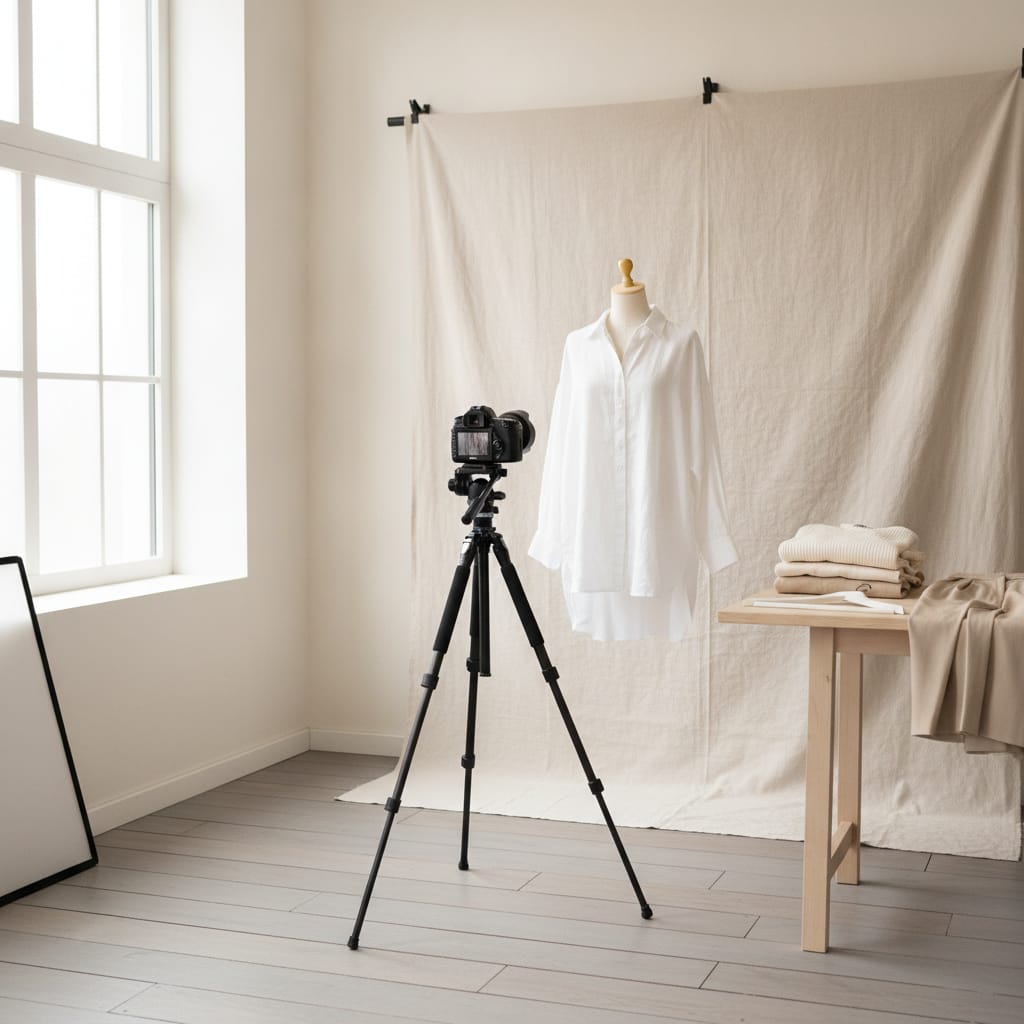
Clothing product photography cost: what do you actually pay?
- The cost of clothing product photography involves more than just the photographer's rate: model, editing, and transport all add up.
- A traditional photo studio comes with high fixed costs that are hard to justify for small webshops.
- A freelance photographer is more flexible, but the extra costs stay largely the same as with a studio.
- With FashionPix, you upload a photo and pay per image — model, background, and editing are all included.
- Always calculate the price per usable photo to fairly compare providers.
What does a traditional studio charge for product photography?
At a traditional photo studio, you're quickly looking at a day rate of several hundred euros for the photographer and studio rental combined. That's just the starting point — model, styling, and editing come on top. For webshops with a large or ongoing collection, costs add up fast.
Professional photo studios usually work with full-day or half-day rates. Within that time slot, you shoot an agreed number of outfits, but the clock starts ticking the moment you walk in. Want to photograph more items than planned? You'll pay for extra hours or a second day.
In most cases, the day rate only covers the photographer and the space. Everything else you need — a model, a stylist, a makeup artist, props — shows up separately on the quote. For a small webshop wanting to shoot dozens of products, this quickly adds up to an amount that's hard to justify.
On top of that, you have little control over the schedule as a client. Cancel last-minute, and in many cases you'll still owe part of the fee. That makes a traditional studio a relatively expensive and inflexible choice for webshops that regularly launch new collections.
Which hidden costs push up the bill?
Beyond the base rate, there are several cost items that are easy to overlook: model fees, location rental, styling, editing, and transport. Together, these extras can easily double or even triple the total price.
A professional model charges an hourly or daily rate. A full day of shooting can already cost a significant amount, depending on the model's experience and agency. Want multiple models for diversity in your webshop? That amount scales up accordingly.
Editing is another sneaky cost. Photos straight out of the camera are rarely ready for publication: backgrounds need touching up, colors need correcting, and imperfections need removing. Retouching is billed by the hour or per photo and can add up fast for a large collection.
Don't forget logistics either. Clothing needs to be shipped to the studio, sometimes steamed or ironed before the shoot, and then shipped back. That time and money count toward the total cost.
Finally: if you rent an external location instead of using a fixed studio, you'll pay location rental on top of the photographer's rate. Even if you go for a supposedly cheaper freelancer, nearly all of these extra costs apply just the same.
- Model fee (hourly or daily rate)
- Location or studio rental
- Styling and wardrobe assistance
- Editing and retouching
- Transport and logistics for the clothing
- Cancellation fees for last-minute changes
Is a freelancer cheaper?
A freelance photographer typically charges a lower hourly rate than a professional studio, but the extra costs stay largely the same. You save on studio rental, but still pay for the model, editing, and possibly a location. As a result, the total cost rarely ends up as low as expected.
Freelancers come in every price range. A beginner charges less than an experienced fashion photographer with an extensive portfolio. That sounds appealing, but a lower hourly rate doesn't automatically mean a lower total price. Editing quality, delivery speed, and consistency across multiple shoots are all factors that are hard to predict in advance.
Another thing to watch is consistency. If you regularly add new products to your webshop, you want all your photos to have the same look and feel. With a freelancer, that depends on the availability of the same person, the same location, and the same lighting conditions — which is tough to guarantee in practice.
For webshops shooting a small collection every now and then, a freelancer can be a great choice. But for webshops with an ongoing stream of new products, the unpredictability in price and scheduling is a real downside.
How does FashionPix lower the cost of product photography?
FashionPix doesn't work like a physical studio: you don't ship anything. You upload one photo of the garment — flat, on a hanger, or shot with your phone — and get back model shots, a white-background pack shot, and product copy. That eliminates the separate costs for a model, location rental, transport, and editing, because those steps simply don't exist anymore.
The big advantage is transparency. You know upfront what you're paying: a model photo costs 1 credit, a packshot 1 too, and product copy in four languages is 1 credit extra. That makes budgeting a lot easier, especially if you launch multiple collections a year and want to keep costs under control.
Because every image is produced the same way, the look is consistent: the same lighting, the same background, the same style across your entire webshop. That's not just better for the customer experience, it's better for your brand image too — and it's exactly what's hard to achieve between two separate shoots.
So FashionPix isn't a replacement for an editorial campaign shoot or lookbook, but an efficient solution for the product photos your webshop needs day to day. Check product photos for what you get per item.
When do you choose which option?
The best choice depends on your volume, budget, and goal. A traditional studio or freelancer suits campaigns and lookbooks. For ongoing product photography for your webshop, an upload-based service is usually the cheapest and most predictable option.
Planning a big launch with a specific creative vision, a unique location, or a campaign for social media and ads? Then a traditional studio or an experienced freelancer is the right call. The higher costs are justified by the creative freedom and the end result.
Want to keep your regular product catalog up to date — adding new items, shooting seasonal pieces, replacing sold-out products? Then speed, consistency, and a predictable price per photo matter a lot more than creative direction.
Some webshops combine both approaches: a big campaign shoot twice a year with a studio or freelancer, and ongoing product photography through an upload service. That way, total costs stay manageable without compromising on brand quality.
Whatever you choose, always run an honest total cost calculation. Don't just compare the hourly or daily rate — factor in all the extras: model, editing, transport, and planning. Only then will you see which option is actually the most cost-effective for your situation.
- Traditional studio: suited for campaigns, lookbooks, and creative shoots with a specific vision.
- Freelance photographer: flexible and personal, but extra costs stay comparable.
- Upload-based (like FashionPix): ideal for ongoing product photography with fixed, transparent pricing.
- Combination: campaign shoot with a studio, daily product photos through an upload service.
How do you calculate the real cost per photo?
Divide the total cost of a shoot — including model, editing, location, and transport — by the number of usable photos you receive. That gives you the real cost per photo and makes it possible to fairly compare different providers.
Many webshop owners compare providers based on hourly or daily rate, but that's an incomplete comparison. A photographer who charges less per hour but works more slowly, or where you still need to buy editing separately, can end up costing more overall than a provider that delivers everything all-in.
Build yourself a simple calculation: how many garments do you want to photograph, how many photos per garment do you need, and what are all the costs involved? Weigh that against the number of usable images you receive. That number — the price per photo — is the only fair benchmark.
Don't forget the time investment either. Coordinating with a studio or freelancer takes time: writing briefs, aligning schedules, giving feedback on edits. With a standardized process, that time investment is significantly lower, which is an indirect cost saving too.
How do you calculate the total cost of a clothing photoshoot?
- Determine your volume. Count how many garments you want to photograph and how many photos per item you need for your webshop, such as front and back, a close-up detail shot, and a photo on a model.
- List all cost items. Note not just the photographer's or studio's rate, but also model fees, styling, location rental, editing, transport, and any cancellation fees.
- Request quotes from multiple providers. Ask for at least three quotes. Make sure all quotes cover the same cost items so you're comparing apples to apples.
- Calculate the price per usable photo. Divide each provider's total cost by the expected number of usable photos. That gives you the real cost per image and makes the comparison fair.
- Weigh quality, speed, and consistency. Don't choose on price alone. Also assess delivery time, consistency across multiple shoots, and how much of your own time goes into coordination.
- The Dutch Photographers' Federation publishes guideline rates for professional photographers in the Netherlands, which serve as a reference for evaluating clothing photography quotes. — Fotografenfederatie
- The share of Dutch consumers buying clothing online keeps growing every year, further driving demand for professional product photography for webshops. — CBS
- Clothing and footwear consistently rank among the best-selling categories in Dutch e-commerce. — Thuiswinkel Markt Monitor
Frequently asked questions
What does clothing product photography cost at a traditional studio?
A traditional photo studio usually charges a day rate for the studio and photographer combined. On top of that come costs for the model, editing, styling, and transport. The total cost quickly adds up to a significant amount, depending on the location and the provider's level.
How do I lower costs without sacrificing quality?
Choose an upload-based service specialized in clothing photography. You submit one photo and pay per image, including model and background. That makes the total cost per photo significantly lower than with a traditional studio, while quality stays professional.
Which hidden costs should I factor in when comparing quotes?
Watch for model fees, location rental, styling, editing and retouching, transport of the clothing, and any cancellation fees. These items often don't appear in the basic rate overview but significantly increase costs. Always ask for an all-in quote.
When is a freelance photographer more cost-effective?
A freelance photographer is a good choice if you have a specific creative vision, want to use a unique location, or are planning a campaign shoot. For ongoing product photography where consistency and a fixed price per photo matter, an upload-based service is usually cheaper.
Written with the help of AI and reviewed by Marcel Timmerman, founder of FashionPix.
Read more
- Optimize product photo SEO
- Product photos for your webshop
- Selling Bridal Wear
- How many product photos per product
- Productfoto’s met model zonder fotoshoot
- Product fotografie kleding
- Model photos
- FashionPix — Product photos, video and copy for your fashion webshop
Ready to get a clear view of your costs?
Run an honest calculation for your situation and compare options on total price per photo. Your first model photo is free, no account and no credit card needed.