Flat Lay Clothing Photography: When Does It Really Work?
Marcel Timmerman · Published 3 juli 2026 · Last updated 4 August 2026
Flat lay photography for clothing is a technique where you lay garments flat and shoot them from above. It's quick, affordable and popular among webshops — but it's not always the smartest choice. This article explains how to do it, what the pros and cons are, and when model photos are the better option.
Flat Lay Clothing Photography: Complete Guide for Webshop Owners
- Flat lay photography for clothing is accessible and fast, but it doesn't show how a garment falls on a body.
- Model photos typically boost conversion for clothing because shoppers get a better sense of how a garment actually fits.
- Flat lay works great as a complement to model photos, for instance for detail shots or social media content.
- The choice between flat lay and model photos depends on your target audience, brand positioning and budget.
- A consistent photo style — whichever you choose — matters at least as much as the style itself.
What exactly is flat lay photography for clothing?
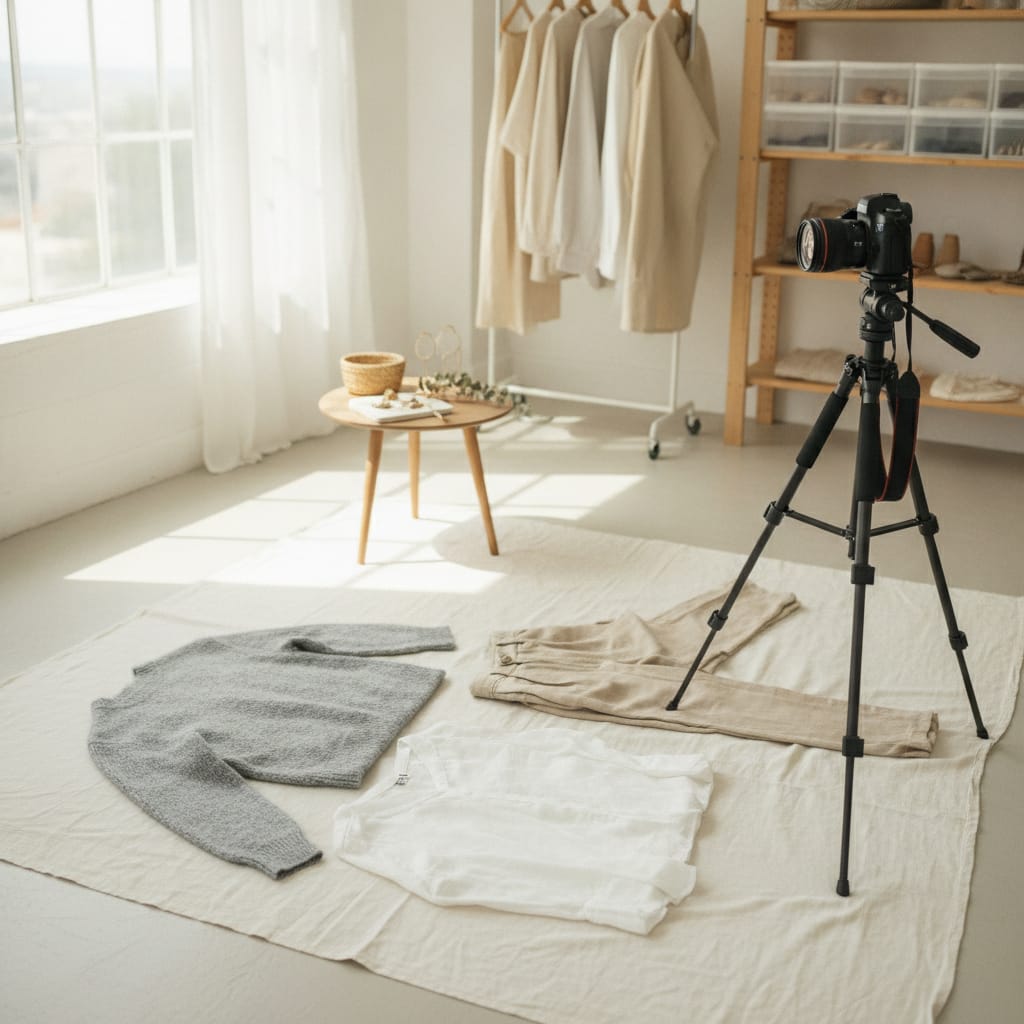
Flat lay photography for clothing is a technique where you lay garments flat on a surface and shoot them straight down from above. The result is a clean, two-dimensional image that shows off the shape, print and color of a garment clearly.
The style originated in food photography and lifestyle content, but has found its way into the fashion industry. Webshops use flat lay photography for clothing to create fast, consistent product images without needing a model or a big photo studio.
A flat lay can be minimalist — a single garment on a white background — or styled with props like jewelry, shoes and accessories that round out the composition. That second variant is often called a 'styled flat lay.' If you want to give a garment shape without using a model, check out ghost mannequin photos.
What makes flat lay photography for clothing appealing for smaller webshops is the low barrier to entry. All you need is a camera or a decent smartphone, an iron, an even surface and enough daylight. That's basically all it takes to get started.
How do you do flat lay photography for clothing properly?
Good flat lay photography for clothing starts with a neatly ironed garment, an even background and diffused daylight or soft artificial lighting. Shoot straight down from above, keep a consistent distance and use a tripod to avoid motion blur.
Preparation largely determines the result. Iron or steam every garment carefully before laying it down. Wrinkles stand out even more in flat lay photography for clothing, since there's no body to keep the fabric taut.
Choose your background deliberately. A white or light grey background is neutral and works for nearly any brand. A wooden floor, linen cloth or colored cardboard adds character, but make sure the background doesn't distract from the product itself.
Light is arguably the most important variable. Soft, indirect daylight — next to a window, for example — gives you nice, even lighting without harsh shadows. Preferably shoot on an overcast day, or use a light diffuser if the sun is too strong.
Consistency is essential when photographing multiple products. Use the same distance, the same lighting and the same composition for every garment. That way your webshop looks professional and cohesive, which builds trust with visitors.
- Iron every garment before shooting
- Use a tripod for a sharp, straight-down shot
- Choose diffused light to avoid harsh shadows
- Keep composition and background consistent across your whole collection
- Shoot in RAW if your camera supports it, for more editing flexibility
What are the pros and cons of flat lay versus model photos?
Flat lay photography for clothing is cheaper and faster than model photography, but it doesn't show how clothing falls on a body. Model photos give buyers a more realistic sense of fit and wearability, which affects both the chance of a purchase and the chance of a return.
The biggest advantage of flat lay photography for clothing is accessibility. You don't need a model, a makeup artist or a big studio. For starting webshops or brands with a large, fast-changing range, that's a serious argument in its favor.
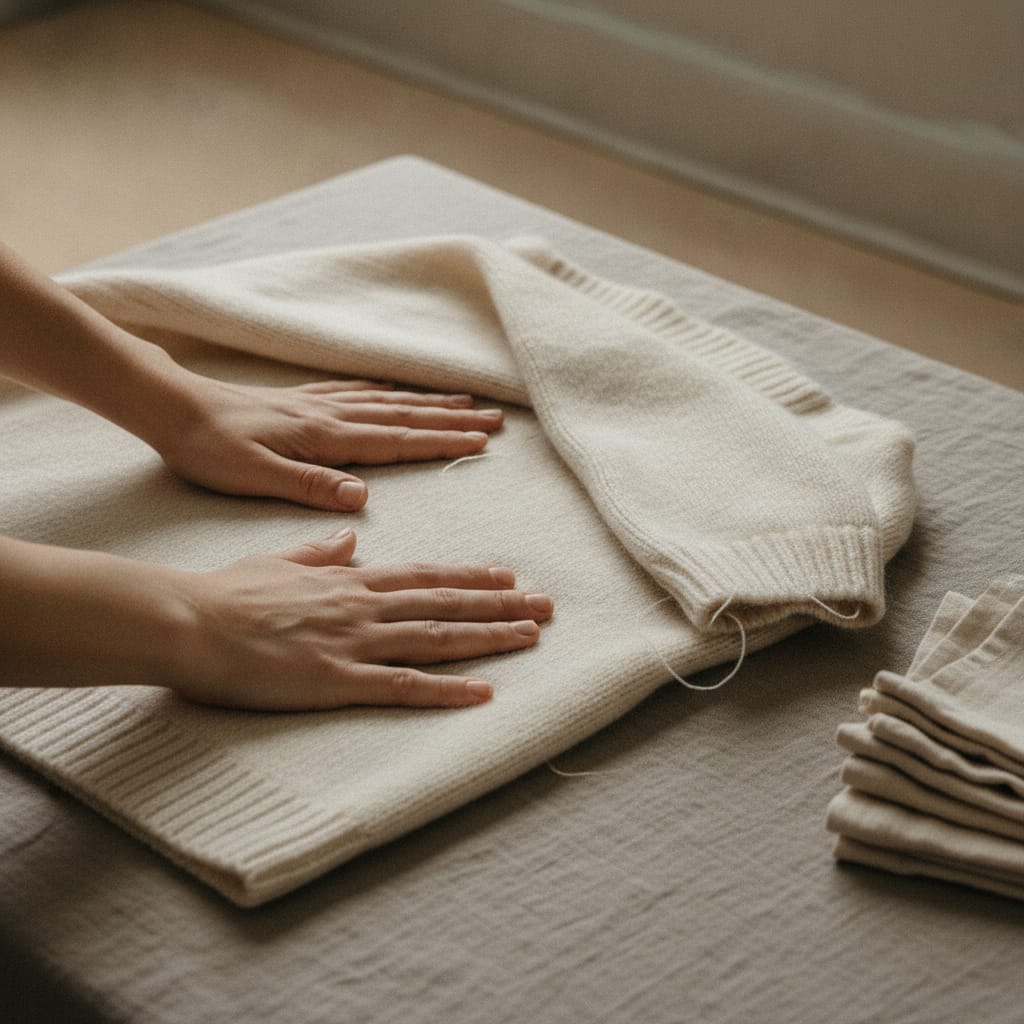
But there's an important downside: clothing is designed to be worn. A sweater lying flat on the floor tells you little about how it drapes over your shoulders, how the waist sits, or how the length compares to an average body. For many buyers, that information is decisive.
Model photos fill that gap. They provide context, show movement and help buyers picture themselves in the garment. That's why larger webshops and brands with a higher average order value almost always choose photos on a model.
A hybrid approach is also possible: use model photos as the main image on the product page and add flat lay as a secondary image for detail shots or to better show color and print. That way you combine the strengths of both styles.
- Flat lay: low cost, quick to execute, no model needed
- Flat lay: less suited to showing fit and wearability
- Model photos: higher production cost, but more context for the buyer
- Model photos: help lower your return rate
- Hybrid approach: combine both styles for the best result
Which photo style drives higher conversion in a clothing webshop?
Research consistently points in the same direction: photos on a model outperform flat lay as the sole product image for clothing. Buyers want to see how something looks worn, not just how it looks lying flat.
That doesn't mean flat lay photography for clothing is worthless. For accessories, jewelry, socks or caps — products where fit matters less — a flat lay works fine as the main image. The style also has clear aesthetic advantages for social media content, lookbooks and email campaigns.
For clothing where fit, length or volume matter — think dresses, pants, jackets and sweaters — a model photo is almost always the better choice for the main image on a product page. It helps buyers judge more accurately whether the garment will suit them.
Brand positioning matters too. A premium or luxury brand that relies solely on flat lay may unintentionally come across as cheaper. Model photos shot in an editorial style fit better with a higher-end brand experience.
If you're considering switching to model photography but don't want to organize the production yourself: with FashionPix you upload a single photo of the garment and get model images back, without needing to set up a shoot. Read more at having product photos made.
When should you go for flat lay photography?
Flat lay photography for clothing is a good choice when you want to photograph a lot of products quickly, have a limited budget, or want to use the style to complement model photos. For social media, detail shots and seasonal content, it's an efficient and visually appealing option.
Starting webshops looking to get their first collection online can achieve a professional-looking result quickly with flat lay. It requires little investment, and you can do it yourself with a smartphone and some attention to light and composition.
Flat lay is also a relevant style for brands that lean heavily on Instagram or Pinterest. The bird's-eye composition suits visually appealing posts and fits the aesthetic of those platforms.
Consider also using flat lay for 'outfit compositions': a complete look laid out like a puzzle, including shoes, bag and accessories. That kind of image works well as inspirational content and can increase average order value by showing buyers multiple products at once.
In short: flat lay photography for clothing isn't an inferior style, but a tool with a specific use case. Once you understand that, you can deploy it smartly as part of a broader visual strategy.
How do you maintain a consistent visual style across your webshop?
Consistency in product photography — whether you choose flat lay, model photos or a mix of both — is essential for a professional look. Write down your choices in a simple style guide and use the same background, lighting and composition across your entire range.
A style guide doesn't need to be complicated. Note which background color you use, at what height you shoot, how you fold or lay out clothing, and which props you add if any. That way you can photograph new products later without them looking different from the rest of your range.
Editing is something a lot of webshop owners underestimate. Make sure you edit all images the same way: same white balance, same brightness, same cropping. That gives your webshop a cohesive, polished feel.
If you're switching from one style to another, consider re-shooting your entire range. A mix of styles on the same webshop looks messy and can undermine visitor trust. Want to lock in that consistency instead of just maintaining it? Read about a fixed model for your webshop.
How do you create good flat lay photography for clothing?
- Prepare the garment. Iron or steam the garment carefully. Wrinkles stand out even more in flat lay, since there's no body to keep the fabric taut.
- Choose your background. Set up an even, clean surface. White or light grey is neutral and works for nearly any brand. Wood or linen adds character, but shouldn't distract from the product.
- Set up your lighting. Use soft, indirect daylight next to a window, or a softbox if shooting indoors. Avoid harsh shadows from direct sunlight or a flash pointed straight at the subject.
- Position your camera straight down. Mount your camera or smartphone directly above the garment. Use a tripod or wall mount to prevent motion blur and keep a consistent angle.
- Lay out and style the garment. Lay the garment flat and make sure the shape looks good. Neatly fold or unfold sleeves and legs. Add matching accessories if you want a styled flat lay.
- Shoot and edit consistently. Take several shots and pick the sharpest one. Edit all images the same way: same white balance, brightness and cropping, so your webshop looks cohesive.
- Product pages with photos on a model show a higher click-through rate and conversion for clothing webshops than pages with product-only photos and no model. — Shopify
- Insufficient or inconsistent product photos have been identified in multiple usability studies as one of the main reasons online shoppers abandon a purchase. — Baymard Institute
- For the majority of buyers, photos are the deciding factor in the purchase decision. — Etsy
Frequently asked questions
Is flat lay photography for clothing suitable for all types of garments?
Flat lay works well for items with an interesting print, color or texture, and for accessories where fit matters less. For garments where fit, volume or length are central — like dresses, pants and jackets — a model photo is the better choice for the main image on a product page.
What equipment do I need for flat lay photography for clothing?
You don't need a professional camera. A modern smartphone with a good camera, a tripod or wall mount, an even background and enough diffused daylight are enough to get started. An iron or steamer is at least as important as the camera itself.
Can I combine flat lay with model photos in one webshop?
Yes, a hybrid approach works well. Use model photos as the main image on the product page and add flat lay as a secondary image for detail shots or color representation. Just make sure both styles share the same look and color palette, so your webshop looks cohesive.
Does flat lay photography affect my webshop's return rate?
Indirectly, yes. Buyers who can't properly judge how a garment falls often order the wrong size or receive a product that doesn't meet their expectations. Model photos provide more context on fit and wearability, which can help lower your return rate.
Written with the help of AI and reviewed by Marcel Timmerman, founder of FashionPix.
Read more
- Virtual Fitting Room Ecommerce
- Tools die kleding op een model zetten
- Clothing Product Photography Cost
- Optimize product photo SEO
- Productfoto’s met model zonder fotoshoot
- Packshot
- FashionPix — Product photos, video and copy for your fashion webshop
Ready to take your product photos to the next level?
Whether you choose flat lay, model photos or a combination of both — the best style is the one that's consistent and fits your target audience. Your first model photo is free, no account and no credit card needed.